Panels
Time and peak memory as the number of panels grows, at 8 periods each, for three models:
Difference GMM: two-step, uncollapsed instruments (lags 2 to 8 of y, 1 to 8 of x), w IV-style, year effects, Windmeijer-corrected standard errors: 55 instruments.
Collapsed difference GMM: the same with the instruments collapsed, the only kind systemgmmkit’s native engine builds.
System GMM: the collapsed model, with the levels equation.
Every library gets the same model (benchmarks/_models.py). dpd-stream also
computes, as by default, the identification and difference-in-Hansen tests,
which the others do not.
The run was on an EC2 spot instance (c8id.4xlarge: 16 vCPUs, 32 GiB, local NVMe), with a 1,800-second limit per fit and the benchmarks’ memory capped at 96% of it. Each fit is in its own process; dpd-stream’s is timed after a warm-up fit that loads numba’s kernels. Figures show every fit that finished; the others are listed below each one.
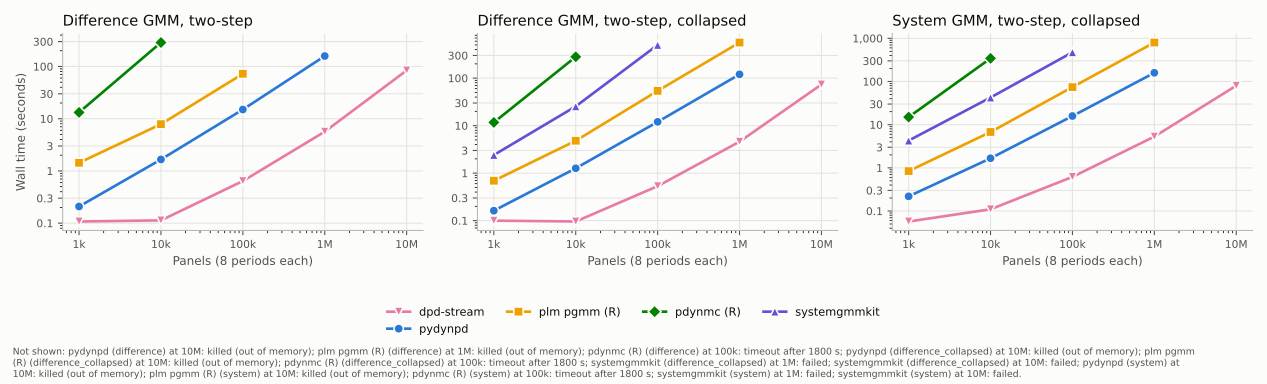
dpd-stream fits a million panels (8 million rows) in 4.6 to 5.7 seconds, and ten million panels (80 million rows) in 74 to 84 seconds.
pydynpd takes 120 to 159 seconds at a million panels, and runs out of memory at ten million.
plm takes 563 and 799 seconds at a million panels in the collapsed models, and runs out of memory there with uncollapsed instruments. It runs out of memory at ten million.
pdynmc takes 280 to 340 seconds at 10,000 panels and times out at 100,000.
systemgmmkit takes 475 to 500 seconds at 100,000 panels. At a million panels its panel-time-grid check refuses the data (see differences between implementations).
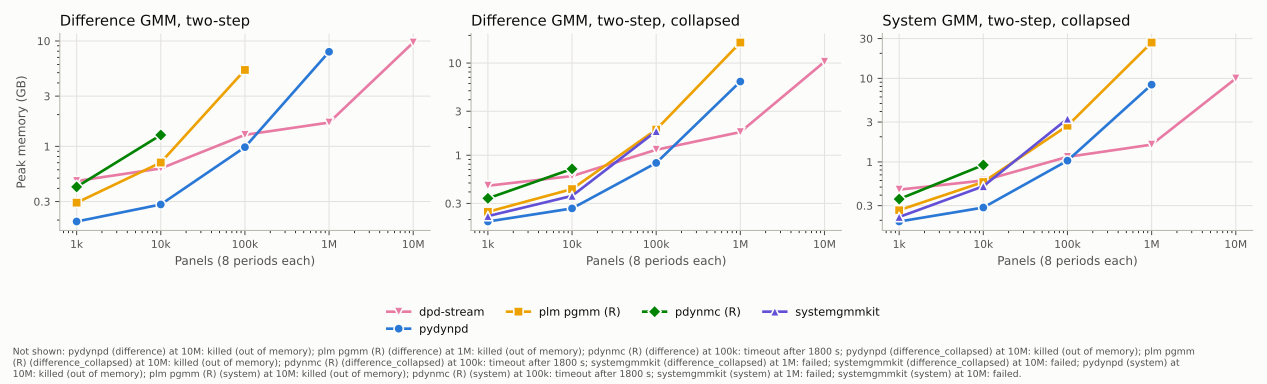
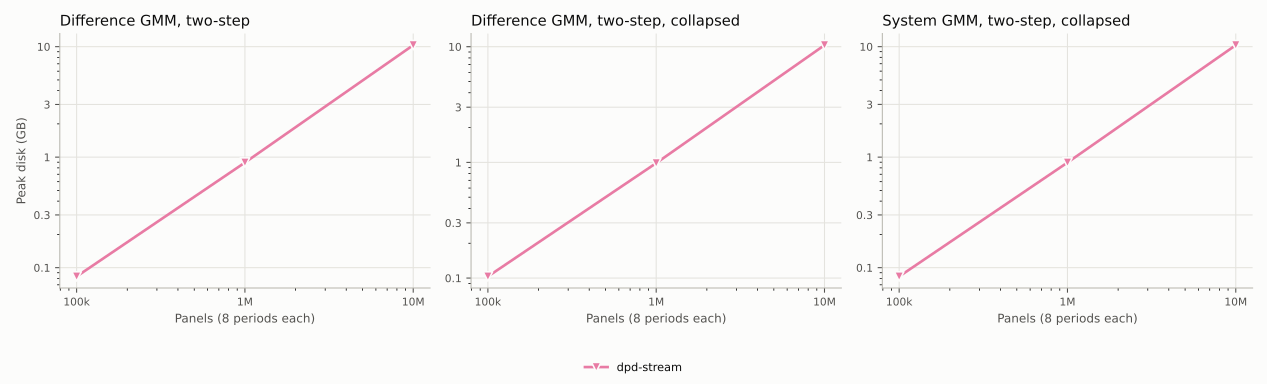
dpd-stream’s memory is mostly fixed: about 0.5 GB of libraries and numba’s compiled kernels. It reaches 1.6 to 1.7 GB at a million panels, where pydynpd needs 6.2 to 8.2 GB and plm up to 26 GB, and 9 to 10 GB at ten million. The data themselves go to disk, in blocks of whole panels (10 GB at ten million panels):
Agreement. In difference GMM, collapsed or not, all libraries that finished agree with dpd-stream to 3e-13 or better. In system GMM pydynpd agrees with dpd-stream (which follows xtabond2) to 3e-14. plm and pdynmc enter the year effects in the levels equation their own way, and systemgmmkit uses IV-style instruments in the levels equation only, so their estimates differ by 0.1 to 0.14.
The numbers are in benchmarks/results/scale.csv.