Benchmarks
match-stream is compared with MatchIt and Matching (R), pymatchit, fastmatch,
and with the bare operations underneath it (a nearest-neighbor search, a
group-by, an as-of join), on simulated data from 10,000 to 100 million units.
The suites are in benchmarks/; its README says how to run them.
The short version:
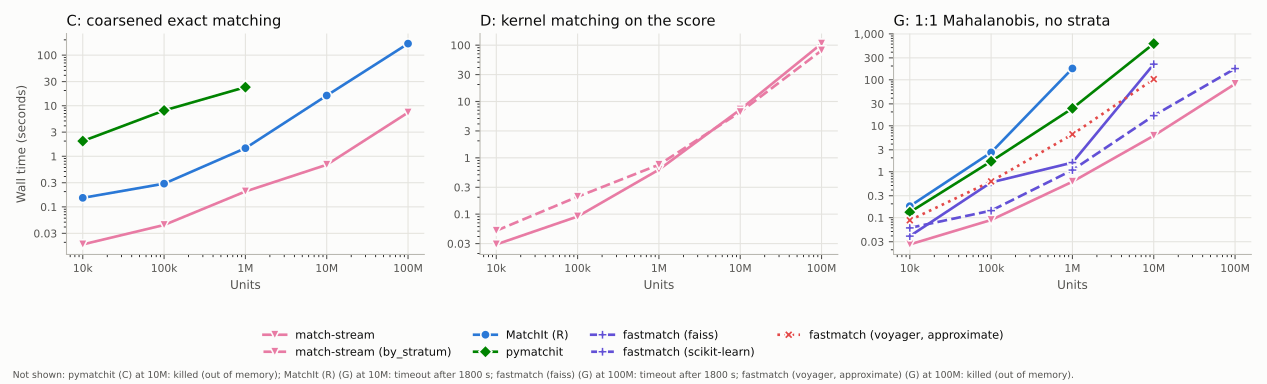
Against the matching packages, match-stream is 6 to 35 times faster than MatchIt at 10 million units where MatchIt finishes, and it finishes where the others run out of memory or time. pymatchit and R’s Matching are slower still.
Against the bare search, matching costs little on top of it: with no strata (design G) match-stream takes 81.6 s at 100 million units, and a bare SciPy k-d tree search takes 71.8 s.
Against a simple group-by or join, the specialized shortcuts win: Polars’
group_bydoes coarsened exact matching about 5 times faster than match-stream, and itsjoin_asofdoes design A about 9 times faster. They answer a narrower question, with no calipers, no choice of controls and no weights.The in-memory path has a limit. Design H (1:1 Mahalanobis matching without replacement, with covariate calipers) at 100 million units needs more than the 32 GB of the test machine. Use
memory="by_stratum"there: 187 s and 9.2 GB.
What is measured
Two suites, on simulated units in 500 exact strata:
Scale (
scale_benchmark.py): eight designs, from 1:1 matching on the score with a caliper to coarsened exact matching, kernel matching and Mahalanobis matching, with and without replacement:design
what it matches
A
1:1 on the score, with replacement, caliper 0.2 SD
B
1:1 Mahalanobis, with replacement, exact strata
C
coarsened exact matching, 5 bins
D
kernel matching on the score
E
3:1 on the score, with replacement, three calipers
F
1:1 on the score, greedy, without replacement, three calipers
G
1:1 Mahalanobis, with replacement, no strata
H
1:1 Mahalanobis, without replacement, exact strata, calipers on two covariates
match-stream runs each in memory and by stratum. The others are MatchIt and Matching (R), pymatchit, fastmatch (faiss, scikit-learn and voyager backends), Polars’
join_asof(design A) andgroup_by(design C), and, as a floor for the Mahalanobis designs B and G, a bare SciPy k-d tree and an exact faiss search.Effects (
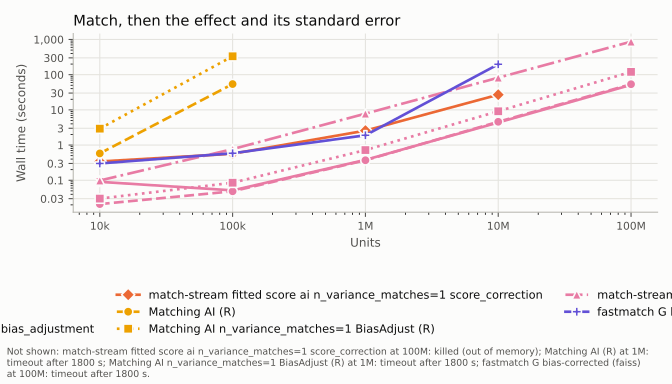
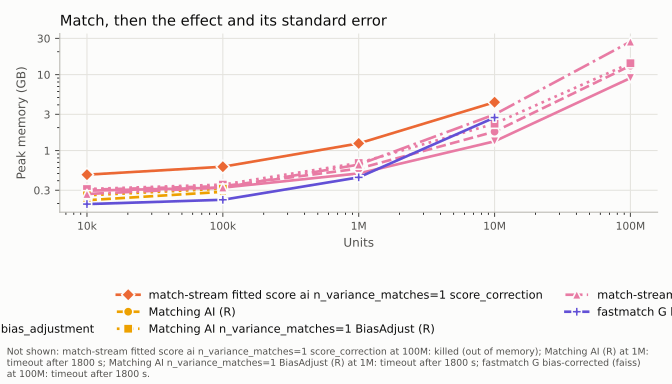
effects_benchmark.py): matching followed by the effect and its standard error. It covers influence-function, clustered and Abadie-Imbens standard errors, the bias adjustment, and the Abadie-Imbens (2016) correction for a fitted score, against R Matching’s Abadie-Imbens standard errors and fastmatch’s bias-corrected standard error.
For each configuration: wall time, peak memory, peak disk, and the estimate’s largest difference from match-stream’s, which checks that every library made the same design.
The runs were on one AWS EC2 spot instance (a c8id.4xlarge: an Intel Xeon
6975P-C with 16 vCPUs and 30.8 GB of memory, local NVMe disk, Linux; the
benchmark process capped at 96% of memory).
benchmarks/results/machine.json has the details and the versions. Each
point is a single run, and a spot instance can be interrupted and restarted;
an interrupted configuration is run again from the start. Read the
differences between libraries, which are several-fold, rather than the kinks
in a line. A configuration that fails, runs out of memory or
exceeds 30 minutes is not run at larger sizes.
Results: matching
Wall time and peak memory at 10 million and 100 million units. “Memory” and “time” mean the library ran out of memory or exceeded 30 minutes.
design |
match-stream |
MatchIt |
pymatchit |
other |
|---|---|---|---|---|
10 million units |
||||
A |
3.6 s, 1.4 GB |
20 s, 3.0 GB |
120 s, 4.7 GB |
|
B |
6.2 s, 2.7 GB |
171 s, 4.5 GB |
171 s, 4.4 GB |
k-d tree 5.6 s, 2.5 GB |
C |
0.7 s, 1.9 GB |
16 s, 3.2 GB |
memory |
|
D |
7.2 s, 1.7 GB |
|||
E |
5.0 s, 2.0 GB |
61 s, 3.4 GB |
1,003 s, 5.8 GB |
|
F |
4.4 s, 1.9 GB |
35 s, 3.9 GB |
861 s, 5.6 GB |
|
G |
6.1 s, 2.2 GB |
time |
614 s, 4.4 GB |
k-d tree 6.7 s, 2.2 GB |
H |
9.5 s, 3.8 GB |
334 s, 5.3 GB |
time |
|
100 million units |
||||
A |
58 s, 8.2 GB |
284 s, 27.9 GB |
memory |
|
B |
89 s, 21.3 GB |
memory |
memory |
k-d tree 65 s, 20.0 GB |
C |
7.3 s, 13.7 GB |
169 s, 29.6 GB |
|
|
D |
107 s, 10.5 GB |
|||
E |
75 s, 15.5 GB |
1,176 s, 29.6 GB |
memory |
|
F |
57 s, 12.6 GB |
742 s, 29.6 GB |
memory |
|
G |
82 s, 19.7 GB |
k-d tree 72 s, 19.4 GB |
||
H |
memory (by stratum: 187 s, 9.2 GB) |
memory |
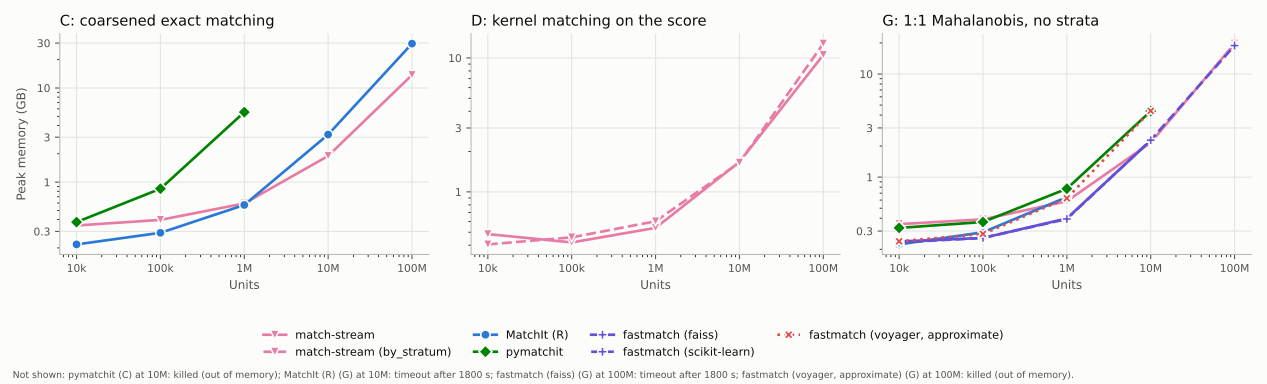
MatchIt gives the same matches as match-stream (the estimates agree to about 1e-14), 5 to 35 times more slowly where it finishes, and it is close to the machine’s memory by 100 million units: 28 to 30 GB in A, C, E and F. In F it completed once and was killed for memory on a second run (shown: the completed run). In G it takes 177 s at 1 million units and exceeds 30 minutes at 10 million, because it has no strata to split the search.
pymatchit runs out of memory or time at 10 to 100 million units in most designs, and was left out of G and H at 100 million. At 100,000 units it disagrees with the others in B, G and H by up to 0.003 in the estimate (see Implementations).
R Matching finishes only up to 100,000 units (44 to 97 s), and exceeds 30 minutes at 1 million in A, B, E, F and H. Its
Matchbyfunction, which matches within strata, handles design A to 10 million units (1,042 s). Its calipers and covariance differ from MatchIt’s in several designs, so its estimates differ by design.fastmatch (design G) agrees exactly with a pre-whitened Euclidean search. With scikit-learn it takes 16.6 s at 10 million units and 176 s at 100 million, against match-stream’s 6.1 s and 82 s. Its faiss backend takes 219 s at 10 million and exceeds 30 minutes at 100 million; its voyager backend is approximate (estimates off by up to 0.01) and runs out of memory at 100 million.
The bare search. In B and G, match-stream is within about 1.4 times of a SciPy k-d tree search on the same data, and is faster than it at 10 million units in G (6.1 s against 6.7 s). Exact faiss (CPU) is much slower here: 13 s at 10 million units in B and 632 s at 100 million, against 6.2 s and 89 s.
Memory. Where it matters,
memory="by_stratum"cuts the peak: B at 100 million units takes 9.1 GB instead of 21.3 GB, for 15% more time. In D, E and F the peak is about 9 to 16 GB either way.
Results: effects
Matching followed by the effect and its standard error, for design A (1:1 on the score, exact strata), with design G for the bias adjustment:
10 million units |
time |
memory |
|---|---|---|
influence-function or clustered standard error |
4.4 s |
1.3 GB |
Abadie-Imbens standard error |
4.6 s |
1.8 GB |
with |
9 s |
2.1 to 2.3 GB |
with a fitted score and its correction |
27 s |
4.3 GB |
G with the bias adjustment |
82 s |
3.0 GB |
fastmatch (faiss), G with its bias-corrected standard error |
197 s |
2.7 GB |
R Matching’s Abadie-Imbens standard errors give the same estimates and
standard errors as match-stream’s, to about 1e-15, with and without
n_variance_matches=1 and the bias adjustment. At 100,000 units (match-stream
against R) they take 0.05 s against 54 s, 0.07 s against 307 s, and 0.09 s
against 333 s for the bias adjustment. R exceeds 30 minutes at 1 million
units in all three.
At 100 million units the first three rows take 51 s, 54 s and 113 to 120 s, and G with the bias adjustment takes 865 s and 27 GB. The fitted score’s correction needs more memory than the 32 GB machine has at that size, and fastmatch’s takes more than 30 minutes.
Figures
The designs with exact strata (A, B, E, F and H):




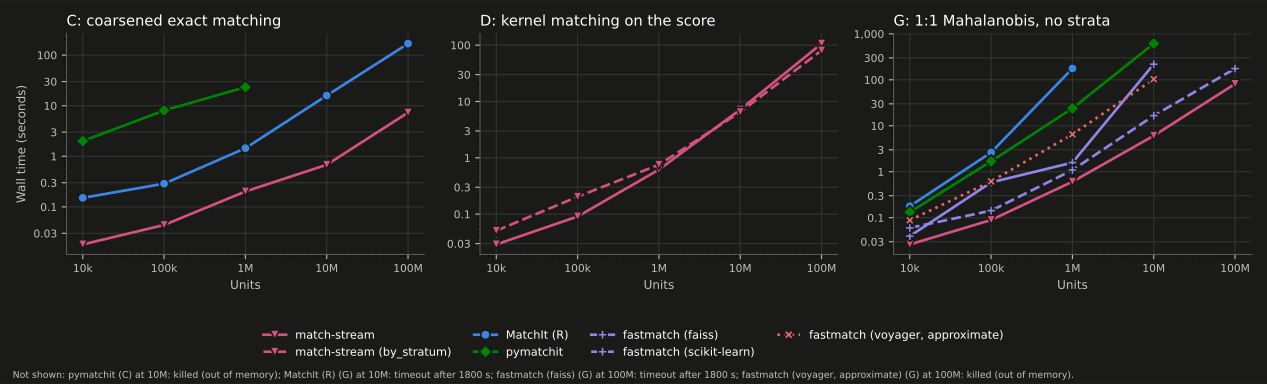
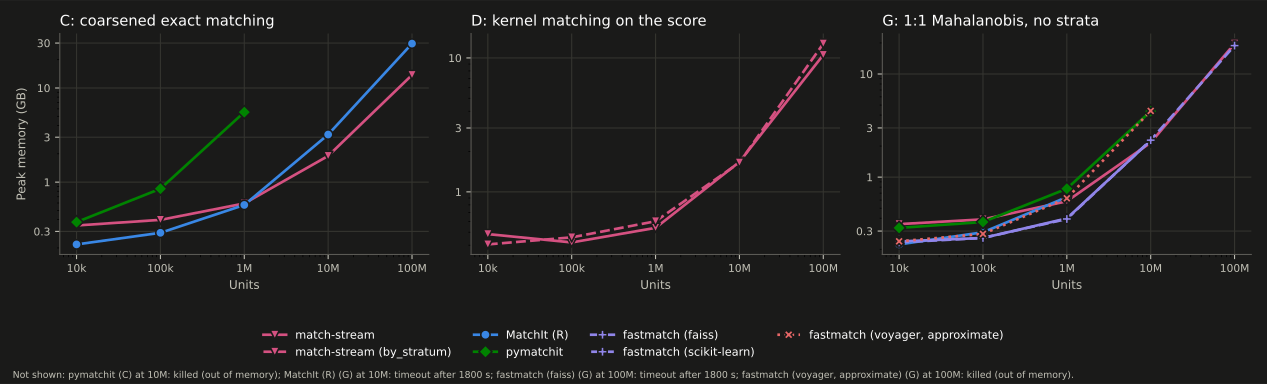
Coarsened exact matching, kernel matching and the Mahalanobis match without strata (C, D and G):
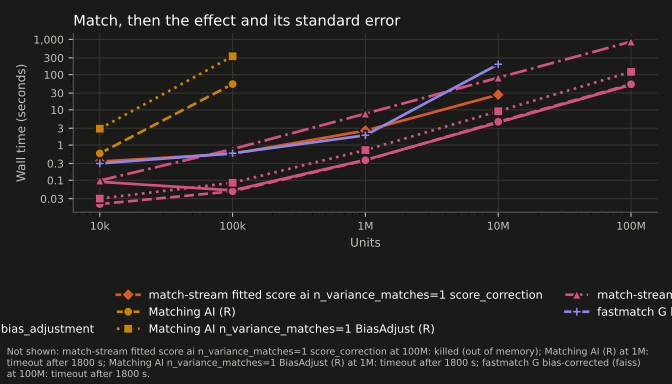
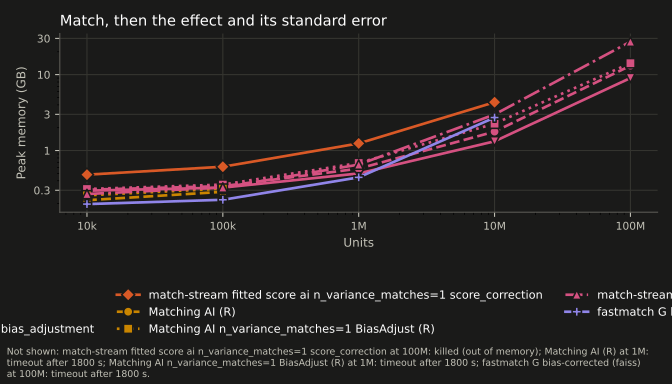
Matching and the effect with its standard error:
Points for runs that failed, ran out of memory or timed out are left off the
lines. Peak disk, which only the by-stratum runs use, is in
benchmarks/results/*.csv.
Agreement
Every library is asked for the same design, and the estimate’s largest
difference from match-stream’s is recorded (max_abs_diff in the CSVs):
R Matching’s Abadie-Imbens standard errors agree with match-stream’s to about 1e-15 (every variant, up to 100,000 units, the largest size it finishes).
MatchIt, and the SciPy k-d tree, agree with match-stream’s estimate to about 1e-14 in every design they support, at every size. The by-stratum path agrees to about 1e-15.
faiss, which searches in single precision, agrees to about 5e-5 at 10 million units.
fastmatch on pre-whitened covariates agrees exactly. Its default Mahalanobis metric does not compute a Mahalanobis distance (see Implementations).
Where a package differs by design (R Matching’s calipers and covariance,
Matchby, pymatchit’s Mahalanobis, voyager’s approximate index), the difference is reported, not hidden.