Swissmetro
The conditional logit of Swissmetro (Bierlaire, Axhausen and Abay, 2001), a stated-preference survey in which 1,192 Swiss travellers each chose among the train, their car and a proposed maglev, the Swissmetro, in nine scenarios. It is the example data of Biogeme, xlogit and jaxlogit. The model is Biogeme’s first example:
with constants for the train and the car (the Swissmetro the reference), on the commuting and business trips with a known choice (6,768 choice sets), the times and costs in hundreds of minutes and francs, the cost zero for holders of an annual pass, and the car available only to car owners. logit-stream’s estimates on the survey are Biogeme’s published ones: ASC_TRAIN −0.701, ASC_CAR −0.155, B_TIME −1.278, B_COST −1.084, log-likelihood −5,331.252.
To see how the libraries scale, larger samples are drawn from the 6,768 choice sets with replacement, up to 10 million (28 million rows of alternatives): the estimates stay those of the survey, up to sampling, while the data grow. Each library gets the data as it takes them: logit-stream, pylogit and statsmodels the long format with the available alternatives only; xlogit and jaxlogit, which need every set to have the same alternatives, all three with an availability indicator. jaxlogit fits mixed logit only, and runs here with no random parameters, which is this model.
Results
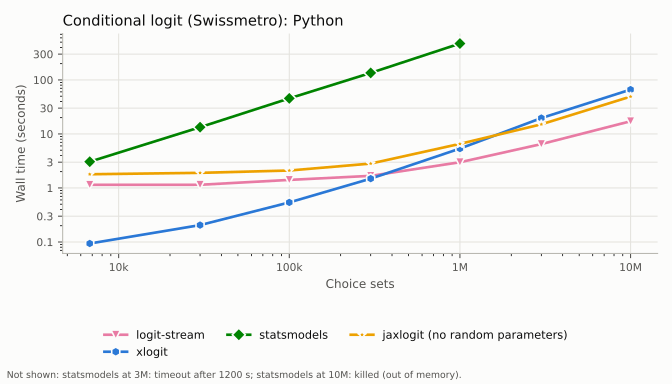
On the survey itself, xlogit is the fastest (0.09 s against logit-stream’s 1.1 s, most of which is fixed overhead); R’s
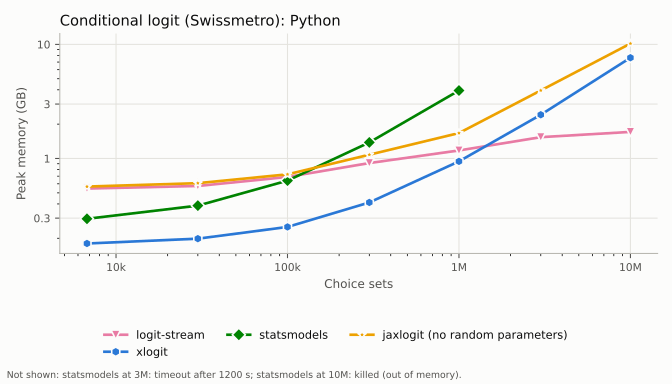
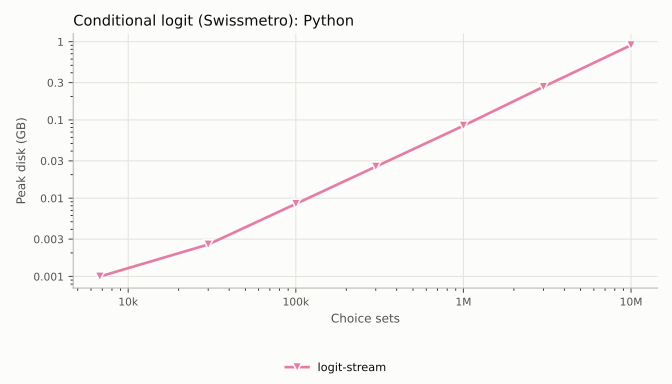
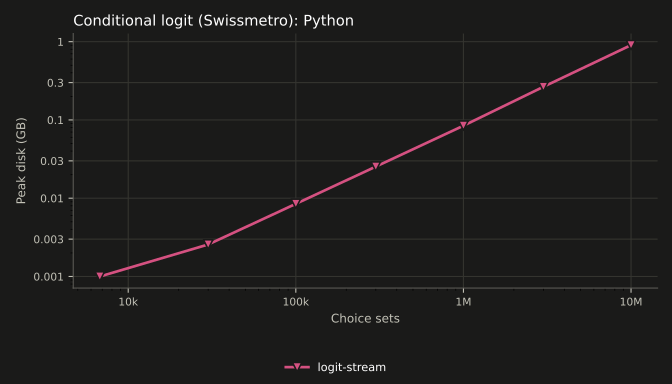
clogit,mlogitand Biogeme take 0.6 to 0.7 s. xlogit and logit-stream draw level at about 300,000 choice sets.From a million choice sets, logit-stream is the smallest, and nearly the fastest. At 10 million sets (28 million rows of alternatives) it took 17 s and 1.7 GB, against 49 s and 10.2 GB for jaxlogit, 66 s and 7.6 GB for xlogit, 148 s and 20 GB for
clogitand 388 s and 25 GB formlogit. Biogeme was faster, at 14 s, on 9.7 GB. logit-stream’s memory rose by 0.5 GB from 1 to 10 million sets; the others’ grow in proportion to the data, by 0.7 to 2.5 GB per million sets.jaxlogit costs about 2 s of compilation up front. After that it scales a little better than xlogit, which it passes at 3 million sets. Both pad every choice set to all three alternatives, about 7% more rows here.
statsmodels’
ConditionalLogitis two orders of magnitude slower (8 minutes at a million sets) and timed out at 3 million.pylogit reproduces the survey’s estimates, but needed 2.3 GB for it and ran out of memory at 30,000 sets. It runs on current Python and NumPy only with compatibility aliases, which the benchmark sets.
The nested logit (the train and the car in a nest; Biogeme’s example, the nesting parameter estimated) took logit-stream 33 s and 3.8 GB at 10 million sets, against 119 s and 28 GB for Biogeme;
mlogittook 223 s at 3 million sets and ran out of memory at 10 million. On the survey itselfmlogitand Biogeme are a little faster (0.9 s and 1.0 s against 1.2 s).
xlogit, jaxlogit, pylogit, Biogeme, clogit and mlogit agree with
logit-stream to within 1e-5 (clogit, 6e-13) at every size where they
finished; statsmodels to within 5e-4 (it stops on its own, looser criterion).
The nested logit’s estimates agree to within 1e-4.
Tables
The numbers behind the figures. A dash means the library was not run at that size, because it failed or timed out at a smaller one.
Conditional logit
Wall time (seconds)
choice sets |
logit-stream |
xlogit |
pylogit |
statsmodels |
jaxlogit (no random parameters) |
Biogeme |
clogit (R survival) |
mlogit (R) |
|---|---|---|---|---|---|---|---|---|
6,768 |
1.1 |
0.09 |
0.71 |
3.1 |
1.8 |
0.70 |
0.57 |
0.71 |
30,000 |
1.1 |
0.21 |
out of memory |
13.3 |
1.9 |
0.74 |
0.98 |
1.6 |
100,000 |
1.4 |
0.54 |
– |
45.5 |
2.1 |
0.84 |
2.1 |
3.8 |
300,000 |
1.7 |
1.5 |
– |
135 |
2.8 |
1.1 |
4.5 |
10.0 |
1,000,000 |
3.0 |
5.4 |
– |
471 |
6.6 |
2.3 |
14.2 |
32.6 |
3,000,000 |
6.5 |
19.7 |
– |
timeout |
15.1 |
4.8 |
44.8 |
110 |
10,000,000 |
17.2 |
66.2 |
– |
out of memory |
49.1 |
14.2 |
148 |
388 |
Peak memory (GB)
choice sets |
logit-stream |
xlogit |
pylogit |
statsmodels |
jaxlogit (no random parameters) |
Biogeme |
clogit (R survival) |
mlogit (R) |
|---|---|---|---|---|---|---|---|---|
6,768 |
0.55 |
0.18 |
2.30 |
0.30 |
0.57 |
0.66 |
0.36 |
0.38 |
30,000 |
0.57 |
0.20 |
out of memory |
0.39 |
0.61 |
0.74 |
0.40 |
0.45 |
100,000 |
0.69 |
0.25 |
– |
0.64 |
0.73 |
0.83 |
0.55 |
0.68 |
300,000 |
0.91 |
0.41 |
– |
1.38 |
1.08 |
1.07 |
0.99 |
1.19 |
1,000,000 |
1.18 |
0.94 |
– |
3.94 |
1.67 |
1.71 |
2.18 |
3.10 |
3,000,000 |
1.54 |
2.42 |
– |
timeout |
3.95 |
3.95 |
5.65 |
7.58 |
10,000,000 |
1.71 |
7.64 |
– |
out of memory |
10.17 |
9.70 |
20.32 |
25.01 |
Nested logit
Wall time (seconds)
choice sets |
logit-stream |
Biogeme |
mlogit (R) |
|---|---|---|---|
6,768 |
1.2 |
1.0 |
0.88 |
30,000 |
1.2 |
1.2 |
2.6 |
100,000 |
1.6 |
1.9 |
6.5 |
300,000 |
2.2 |
3.8 |
18.9 |
1,000,000 |
4.1 |
9.8 |
67.4 |
3,000,000 |
8.7 |
34.5 |
223 |
10,000,000 |
33.4 |
119 |
out of memory |
Peak memory (GB)
choice sets |
logit-stream |
Biogeme |
mlogit (R) |
|---|---|---|---|
6,768 |
0.56 |
0.68 |
0.39 |
30,000 |
0.61 |
0.79 |
0.48 |
100,000 |
0.75 |
0.98 |
0.78 |
300,000 |
1.00 |
1.50 |
1.35 |
1,000,000 |
1.44 |
3.33 |
3.85 |
3,000,000 |
1.61 |
8.87 |
10.54 |
10,000,000 |
3.78 |
27.92 |
out of memory |