Panels
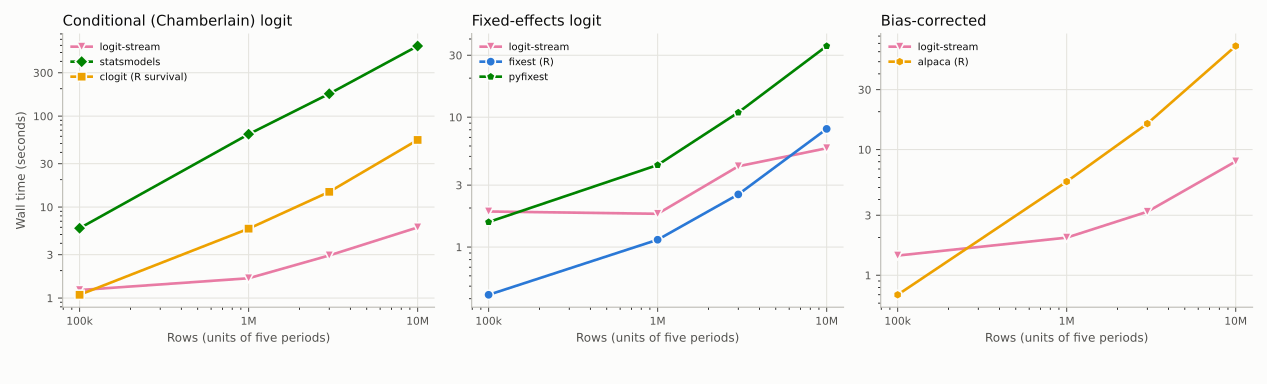
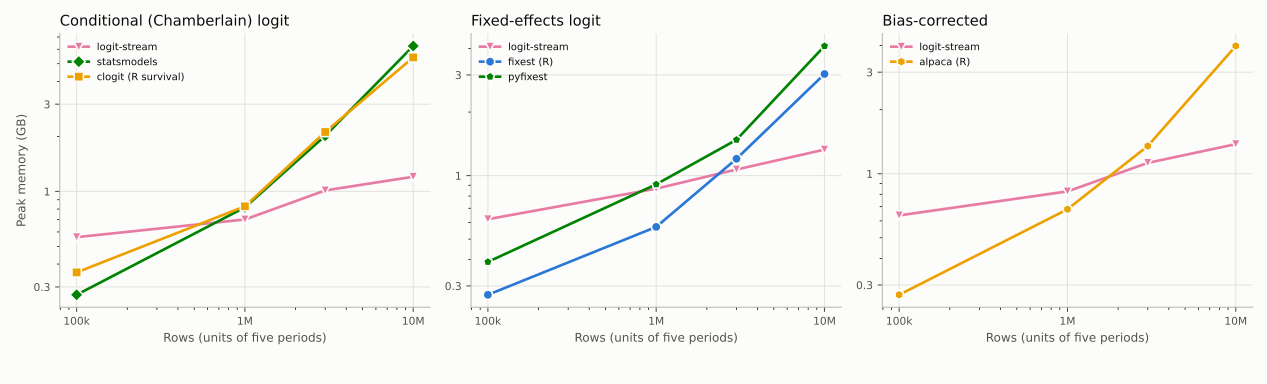
Three ways to fit the logit of a short panel, as the panel grows from 100,000 to 10 million rows (20,000 to 2 million units of five periods):
Chamberlain’s conditional logit (
cfelogit_stream), which conditions the unit effects away; compared with statsmodels’ConditionalLogitand R’ssurvival::clogit.The fixed-effects logit, the unit effects estimated (
logit_stream("y ~ x1 + x2 | unit", ...), which is hdfe-stream’sfeglm_stream); compared with R’sfixestand pyfixest.The same with the analytic incidental-parameter bias correction (
bias_correction=True); compared with R’salpaca, which it reproduces.
The data are logit_stream.simulate.simulate_panel: P(y = 1) is the logistic
of a unit effect plus x1 − 0.5·x2, the unit effects correlated with x1. Each
library gets the same model with its default standard errors (fixest asked
for iid ones, its default with fixed effects being clustered). With five
periods the fixed-effects estimates are biased, by about 30% here; the
conditional and the bias-corrected ones are not.
Results
At 10 million rows (2 million units):
model |
logit-stream |
others |
|---|---|---|
conditional |
6.0 s, 1.2 GB |
|
fixed effects |
5.8 s, 1.3 GB |
fixest 8.1 s, 3.0 GB; pyfixest 35 s, 4.1 GB |
bias-corrected |
8.1 s, 1.4 GB |
alpaca 67 s, 4.0 GB |
The conditional logit is faster than
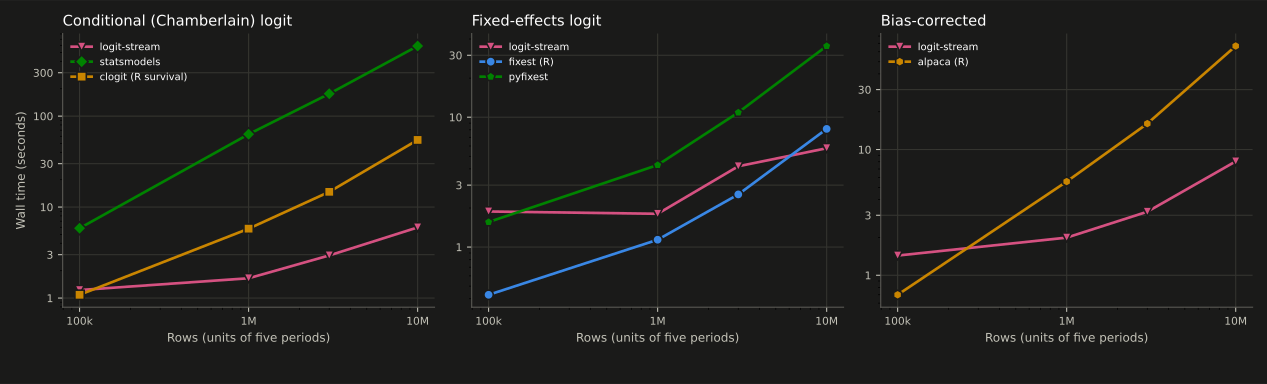
clogitfrom about a million rows (1.7 s against 5.8 s), and statsmodels’, which takes ten minutes at 10 million rows, is 100 times slower. At 100,000 rowsclogitis as fast (1.1 s against 1.2 s).The fixed-effects logit: fixest is faster up to about 3 million rows (0.43 s against 1.9 s at 100,000; 2.5 s against 4.2 s at 3 million), logit-stream above, with less than half of the memory at 10 million. The fixed effects are absorbed, so memory does not grow with the number of units. pyfixest takes the same estimates as fixest, to within 6e-8 of logit-stream’s, and is slower than both from a million rows.
The bias correction costs logit-stream about 40% more than the uncorrected fit at 10 million rows. alpaca is faster below a million rows (0.70 s against 1.4 s at 100,000) and 8 times slower at 10 million. The estimates agree to within 3e-4.
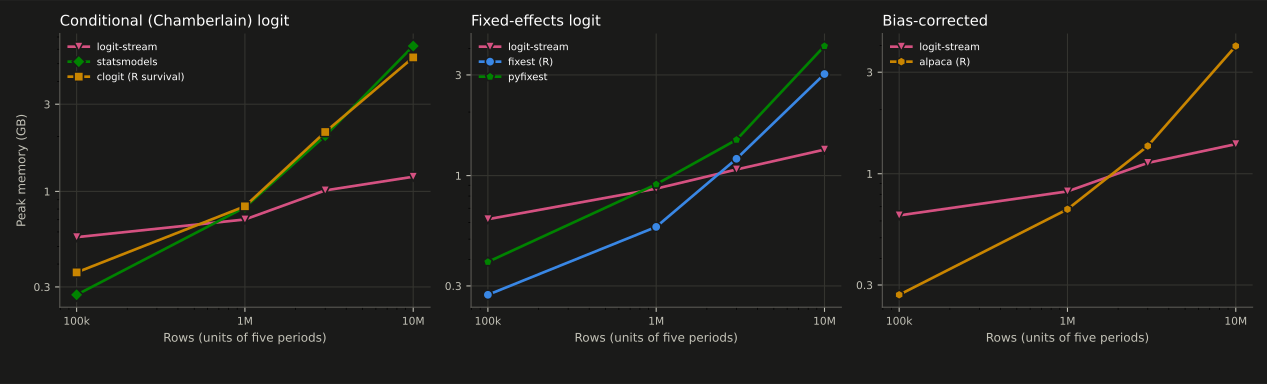
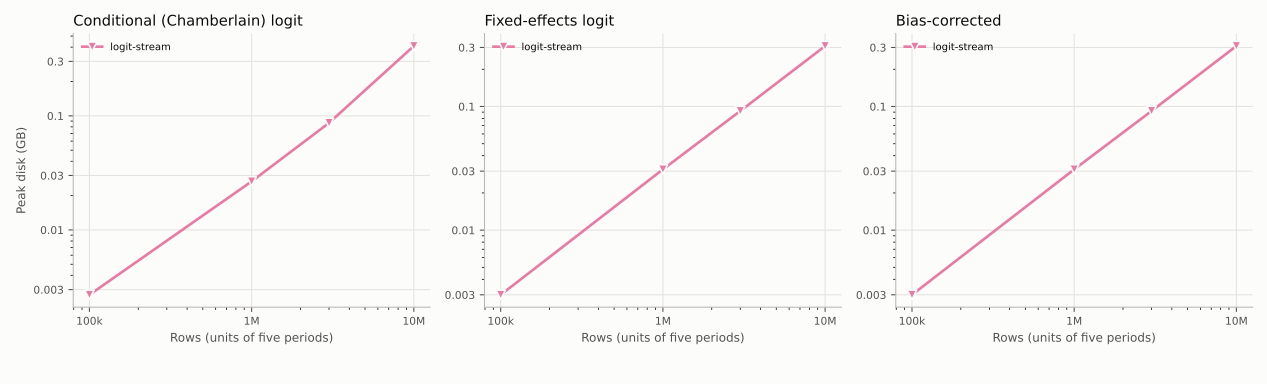
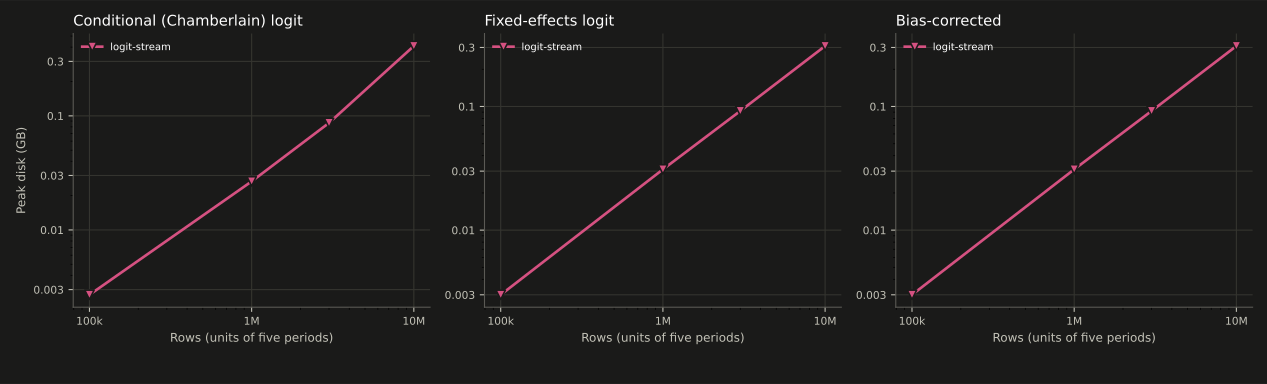
Memory grows slowly in logit-stream (0.6 to 1.4 GB over the range) and its disk use, 3 to 410 MB, is what it writes of the rows it re-reads.
The other libraries’ coefficients agree with logit-stream’s to within 6e-8 (fixest, pyfixest), 3e-4 (alpaca), 5e-15 (
clogit) and 2e-4 (statsmodels).
Tables
The numbers behind the figures.
Conditional logit
Wall time (seconds)
rows |
logit-stream |
statsmodels |
clogit (R survival) |
|---|---|---|---|
100,000 |
1.2 |
5.9 |
1.1 |
1,000,000 |
1.7 |
63.3 |
5.8 |
3,000,000 |
2.9 |
176 |
14.7 |
10,000,000 |
6.0 |
590 |
54.7 |
Peak memory (GB)
rows |
logit-stream |
statsmodels |
clogit (R survival) |
|---|---|---|---|
100,000 |
0.56 |
0.27 |
0.36 |
1,000,000 |
0.70 |
0.82 |
0.83 |
3,000,000 |
1.01 |
2.02 |
2.11 |
10,000,000 |
1.20 |
6.25 |
5.41 |
Fixed-effects logit
Wall time (seconds)
rows |
logit-stream |
fixest (R) |
pyfixest |
|---|---|---|---|
100,000 |
1.9 |
0.43 |
1.6 |
1,000,000 |
1.8 |
1.1 |
4.3 |
3,000,000 |
4.2 |
2.5 |
10.9 |
10,000,000 |
5.8 |
8.1 |
35.3 |
Peak memory (GB)
rows |
logit-stream |
fixest (R) |
pyfixest |
|---|---|---|---|
100,000 |
0.62 |
0.27 |
0.39 |
1,000,000 |
0.87 |
0.57 |
0.91 |
3,000,000 |
1.07 |
1.20 |
1.48 |
10,000,000 |
1.33 |
3.03 |
4.11 |
Bias-corrected
Wall time (seconds)
rows |
logit-stream |
alpaca (R) |
|---|---|---|
100,000 |
1.4 |
0.70 |
1,000,000 |
2.0 |
5.6 |
3,000,000 |
3.2 |
16.1 |
10,000,000 |
8.1 |
66.7 |
Peak memory (GB)
rows |
logit-stream |
alpaca (R) |
|---|---|---|
100,000 |
0.64 |
0.27 |
1,000,000 |
0.83 |
0.68 |
3,000,000 |
1.12 |
1.35 |
10,000,000 |
1.38 |
3.98 |