Poisson and logit
fepois_stream and feglm_stream against pyfixest’s fepois and feglm,
on the simulated AKM panel of the AKM regression benchmark, with two
outcomes simulated from the same worker effects, firm effects and age profile
as its log_earn: a count (Poisson) and a binary outcome (logit). The model is
y ~ age_squared + age_cubed | worker_id + firm_id + year, clustered by worker,
from 25,000 to 5,000,000 workers (212,000 to 42.5 million rows), with firms =
workers / 15. Poisson and logit, many covariates holds the
data fixed and varies the width instead.
pyfixest runs with its LSMR demeaner. Its default, MAP, stops with “Demeaning
failed after 10000 iterations” on these panels at every size tried, from 25,000
workers up, for both models. xhdfe fits linear models only. hdfe_stream runs at
its defaults, with solver="explicit", and with the OLS benchmark’s low-memory
setting (rows_per_bucket=250_000, batch_rows=200_000).
Wherever both libraries finished, the coefficients agree to within 1e-7, the tolerance the iterations reach. For logit, pyfixest keeps workers whose outcome is 1 in every year, which this package drops (see differences from pyfixest), so its N is larger: 8,404,384 against 8,283,651 at 1,000,000 workers. Each configuration runs in its own process, and wall time includes reading the data (how it is measured). The numbers are in benchmarks/results/glm.csv.
python benchmarks/glm_benchmark.py
python benchmarks/plot_benchmarks.py
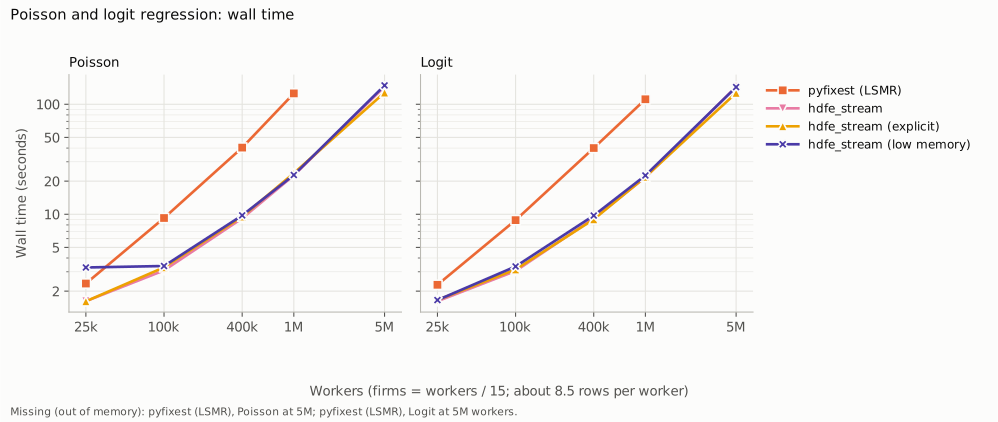
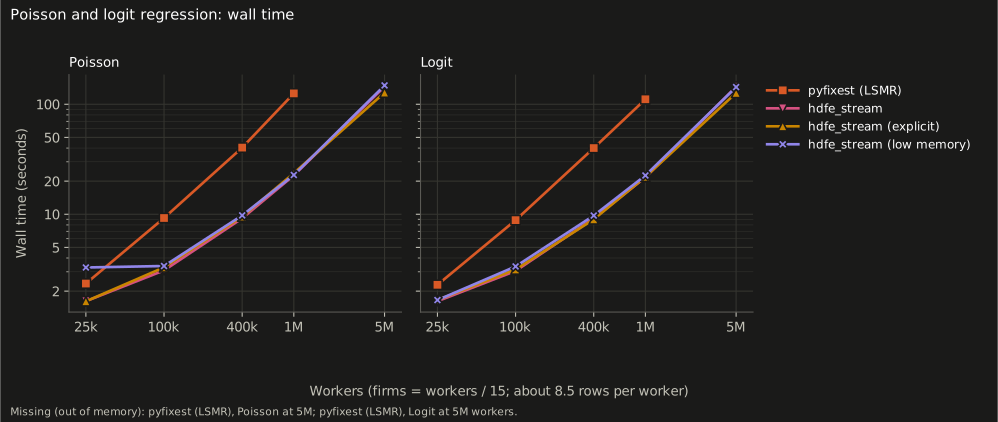
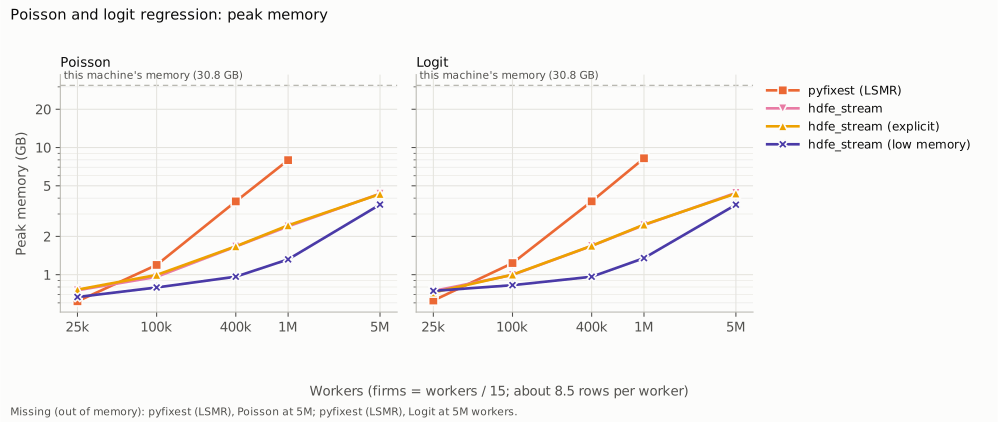
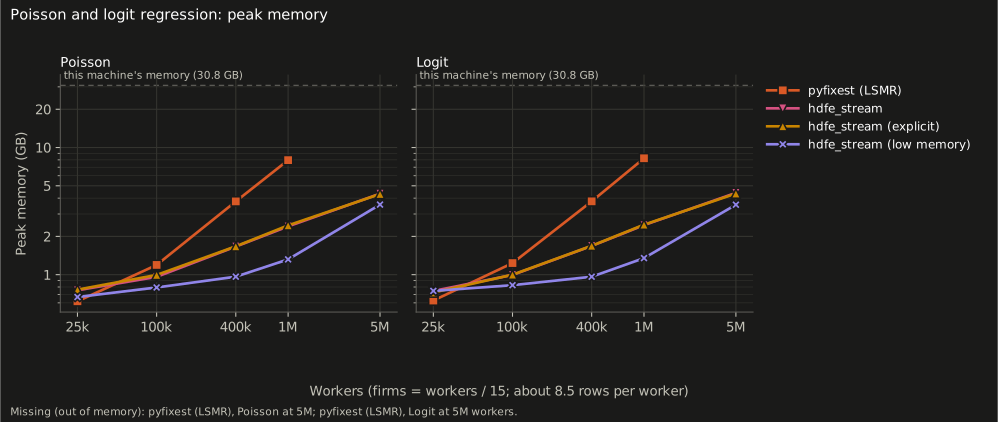
Wall time and peak memory, hdfe_stream at its defaults:
workers |
rows |
Poisson: |
Poisson: pyfixest |
logit: |
logit: pyfixest |
|---|---|---|---|---|---|
25,000 |
212,000 |
1.6 s, 0.8 GB |
2.3 s, 0.6 GB |
1.6 s, 0.7 GB |
2.3 s, 0.6 GB |
100,000 |
850,000 |
3.1 s, 1.0 GB |
9.3 s, 1.2 GB |
3.1 s, 1.0 GB |
8.8 s, 1.2 GB |
400,000 |
3.4 million |
9.2 s, 1.7 GB |
40 s, 3.8 GB |
9.2 s, 1.7 GB |
40 s, 3.8 GB |
1,000,000 |
8.5 million |
23 s, 2.4 GB |
126 s, 8.0 GB |
22 s, 2.5 GB |
111 s, 8.2 GB |
5,000,000 |
42.5 million |
145 s, 4.3 GB |
out of memory |
144 s, 4.4 GB |
out of memory |
Time. From 100,000 workers up, hdfe_stream is 3 to 6 times faster.
Memory. At 5,000,000 workers pyfixest was killed at this machine’s limit of 29.6 GB (of 30.8 GB), for both models. hdfe_stream peaked at 4.3 to 4.4 GB, or 3.6 GB with the low-memory setting, in about the same time. At 25,000 workers pyfixest uses less, as with OLS: an hdfe_stream process costs about 0.8 GB before it has done anything.
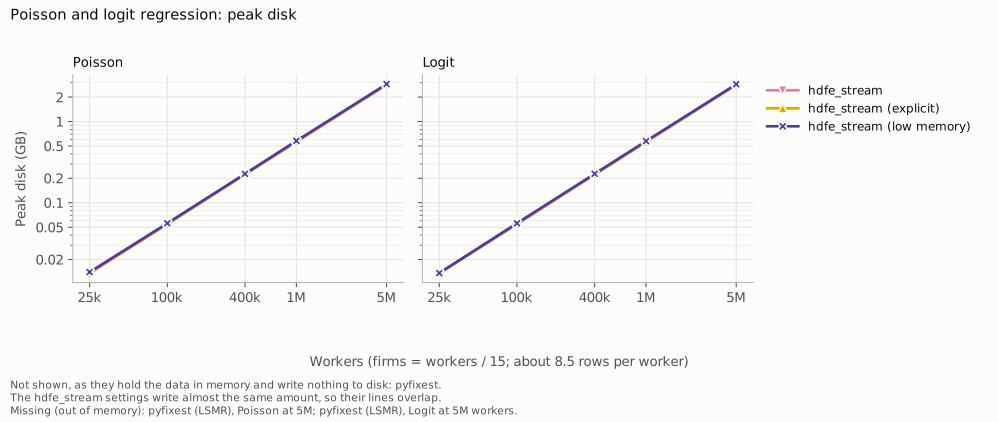
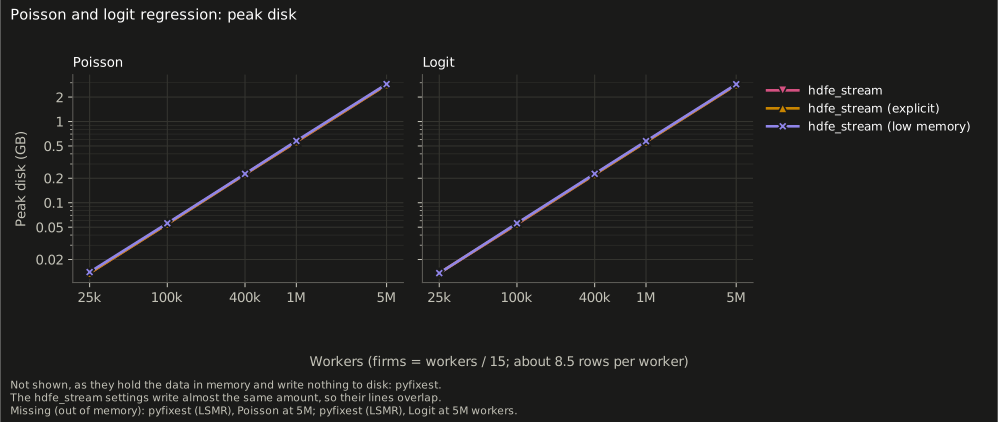
Disk. About 67 bytes per row: 2.8 GB at 42.5 million rows, a little more than OLS on the same design writes (2.6 GB).
Against OLS.
feols_streamfits the same design in 4.9 s at 1,000,000 workers and 22 s at 5,000,000, so a Poisson or logit fit costs 4 to 7 OLS fits.