OLS, IV, logit and probit
hdfe_stream is built for high-dimensional fixed effects, but its estimators also fit plain regressions: OLS and weighted least squares, two-stage least squares, and binary logit and probit, with no fixed effects or with one. These benchmarks ask how it compares there, against the Python and R implementations people use for that job, some of them built for speed rather than for inference: scikit-learn, the Polars plugins polars-ols and polars-ds, NumPy, statsmodels, linearmodels, glum, pyfixest, and R’s lm, glm and fixest.
The data are simulated rows with no panel structure: 10 standard-normal
covariates, a group variable with one group per 20 rows (the fixed effect), an
endogenous regressor with two instruments, and a continuous and a binary
outcome, from 100,000 to 20 million rows
(_harness.general_data_path). The models are
y   ~ x0 + ... + x9                           OLS, no fixed effects
y   ~ x0 + ... + x9 | g                       OLS, one fixed effect
yiv ~ x0 + ... + x9 | d ~ z1 + z2             2SLS, and with  | g |  for one fixed effect
yb  ~ x0 + ... + x9                           logit and probit
Each configuration runs in its own process on the same machine as the other CPU benchmarks, and wall time includes reading the Parquet file and turning it into what the library takes (how it is measured). Estimates agree across libraries to 5e-13 (OLS and IV) and 2.4e-7 (logit and probit, where the solvers stop at different tolerances). Everything below is one run per point. The numbers are in ols.csv, iv.csv and binary.csv.
python benchmarks/ols_benchmark.py
python benchmarks/iv_benchmark.py
python benchmarks/binary_benchmark.py
python benchmarks/plot_benchmarks.py
Libraries do different amounts of work, and the rows say so. hdfe_stream and
most others return coefficients with classical standard errors.
scikit-learn, glum and polars-ds’s logistic_reg return coefficients only.
Where a library cannot absorb a fixed effect or fit 2SLS, the row demeans the
data in Polars or pandas first, or runs the two stages by hand, and that work
is in its time; such rows return coefficients, not standard errors that are
right for the fixed effect or the second stage. “NumPy” is the normal
equations on arrays: about the least work an OLS or 2SLS fit can do, and a
floor, not a competitor.
OLS
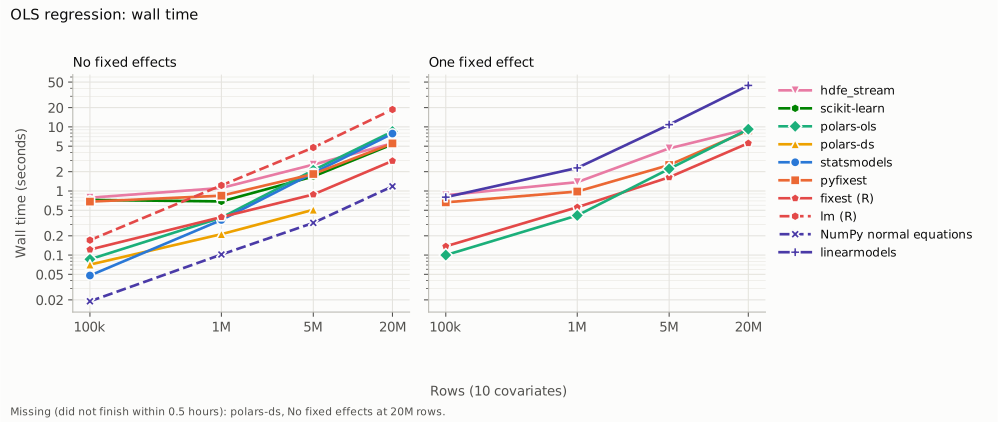
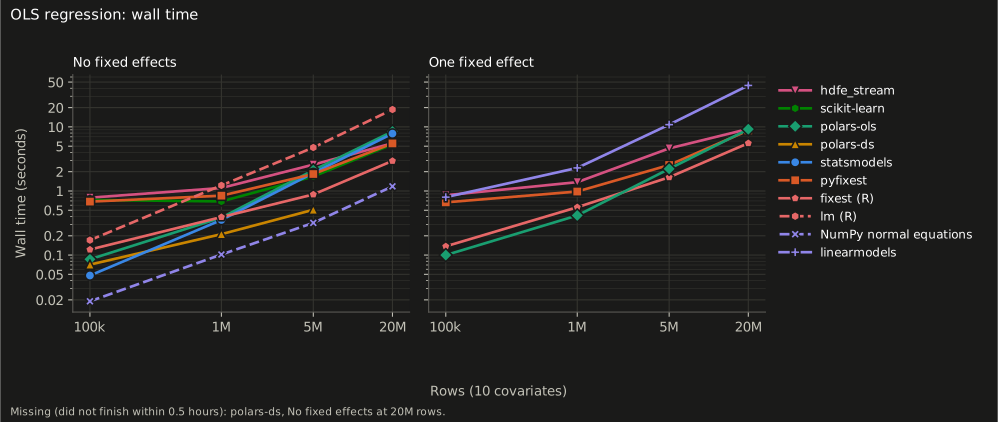
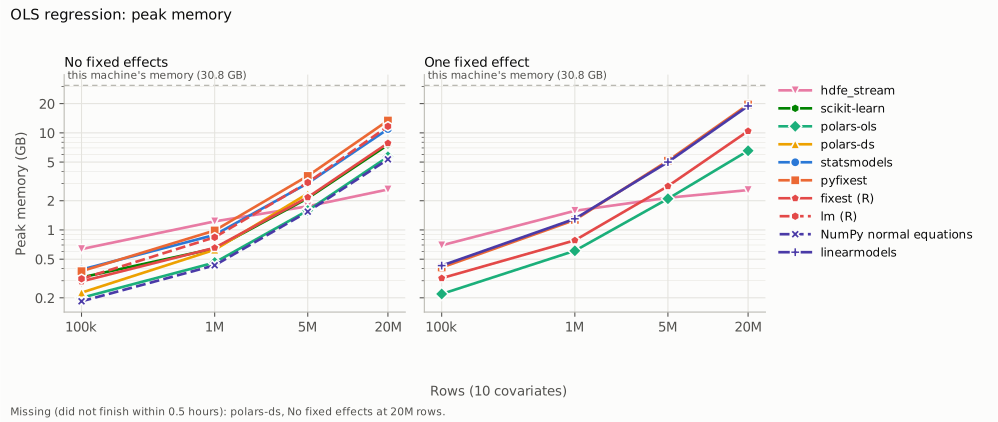
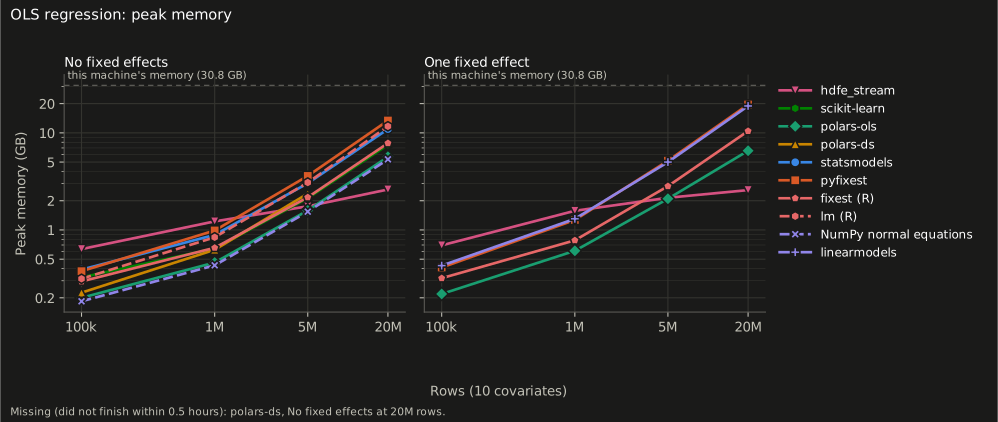
No fixed effects, wall time and peak memory:
rows |
hdfe_stream |
scikit-learn |
polars-ols |
polars-ds |
statsmodels |
pyfixest |
fixest (R) |
lm (R) |
NumPy |
|---|---|---|---|---|---|---|---|---|---|
100,000 |
0.79 s, 0.6 GB |
0.72 s, 0.3 GB |
0.09 s, 0.2 GB |
0.07 s, 0.2 GB |
0.05 s, 0.4 GB |
0.68 s, 0.4 GB |
0.12 s, 0.3 GB |
0.17 s, 0.3 GB |
0.02 s, 0.2 GB |
1 million |
1.1 s, 1.2 GB |
0.69 s, 0.6 GB |
0.38 s, 0.5 GB |
0.21 s, 0.6 GB |
0.35 s, 0.9 GB |
0.84 s, 1.0 GB |
0.39 s, 0.7 GB |
1.2 s, 0.8 GB |
0.10 s, 0.4 GB |
5 million |
2.6 s, 1.8 GB |
1.7 s, 2.1 GB |
2.1 s, 1.6 GB |
0.51 s, 2.4 GB |
1.9 s, 3.0 GB |
1.8 s, 3.6 GB |
0.88 s, 2.2 GB |
4.8 s, 3.1 GB |
0.32 s, 1.5 GB |
20 million |
5.5 s, 2.6 GB |
5.4 s, 7.5 GB |
8.5 s, 5.7 GB |
timeout |
7.9 s, 10.9 GB |
5.5 s, 13.4 GB |
2.9 s, 7.8 GB |
18.6 s, 11.7 GB |
1.2 s, 5.3 GB |
One fixed effect:
rows |
hdfe_stream |
pyfixest |
fixest (R) |
linearmodels |
polars-ols, demeaned first |
|---|---|---|---|---|---|
100,000 |
0.86 s, 0.7 GB |
0.67 s, 0.4 GB |
0.14 s, 0.3 GB |
0.80 s, 0.4 GB |
0.10 s, 0.2 GB |
1 million |
1.4 s, 1.6 GB |
0.98 s, 1.3 GB |
0.56 s, 0.8 GB |
2.3 s, 1.3 GB |
0.41 s, 0.6 GB |
5 million |
4.6 s, 2.1 GB |
2.5 s, 5.2 GB |
1.6 s, 2.8 GB |
10.8 s, 5.0 GB |
2.2 s, 2.1 GB |
20 million |
9.3 s, 2.6 GB |
8.8 s, 19.6 GB |
5.6 s, 10.4 GB |
44.3 s, 18.9 GB |
9.2 s, 6.5 GB |
Time. At 20 million rows
feols_stream(5.5 s) matches scikit-learn (5.4 s) and pyfixest (5.5 s) and is faster than statsmodels (7.9 s) and polars-ols (8.5 s). fixest is faster (2.9 s, with 3 times the memory), and so is the NumPy floor (1.2 s). At 1 to 5 million rows hdfe_stream is slower than the fast libraries: scikit-learn, polars-ols, statsmodels and pyfixest fit 5 million rows in 1.7 to 2.1 s, against 2.6 s. With one fixed effect, at 20 million rows, hdfe_stream (9.3 s) matches demeaning in Polars and then calling polars-ols (9.2 s) and is level with pyfixest (8.8 s), and well ahead of linearmodels’AbsorbingLS(44 s); fixest is faster (5.6 s). At 5 million rows with one fixed effect, pyfixest (2.5 s) is faster than hdfe_stream (4.6 s).Memory. At 20 million rows hdfe_stream peaked at 2.6 GB with no fixed effect and 2.6 GB with one. The others needed 5.3 to 13.4 GB (5.3 GB for the NumPy floor; of the libraries, polars-ols was leanest at 5.7 GB and pyfixest the largest at 13.4 GB); with one fixed effect, 6.5 to 19.6 GB. The gap widens with size, since hdfe_stream holds a batch of rows, not the data.
Small data. Below about a million rows it is slower and heavier: a fit takes about 0.8 seconds at 100,000 rows, against 0.05 to 0.7 s for most of the others, and its process peaks at 0.6 GB there.
polars-ds ran out of the 30 minutes allowed at 20 million rows. Its
lin_reg_report(the call that returns standard errors) takes about a second up to 14 million rows and, on this data, over a minute from 15 million, a slowdown we reproduced on a second machine and did not look into further; its coefficients-onlylin_regfits 20 million rows in 0.6 s. The benchmark times the call with standard errors, as it does for the others.
Two-stage least squares
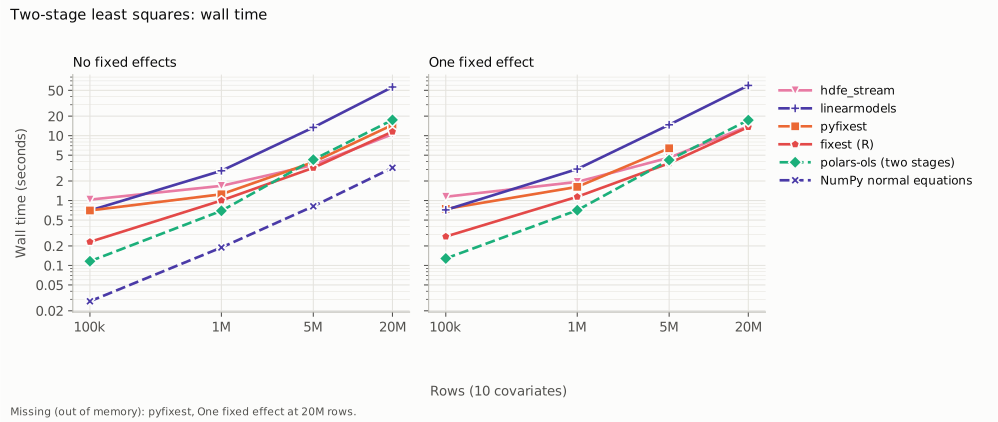
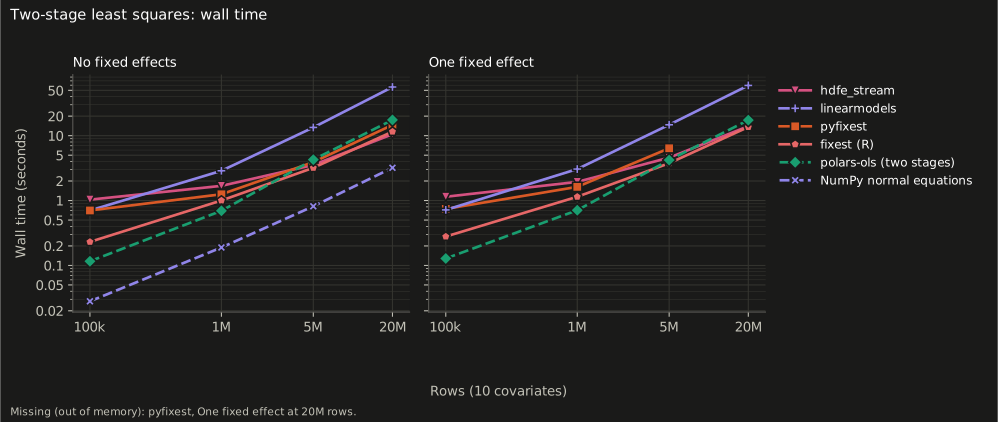
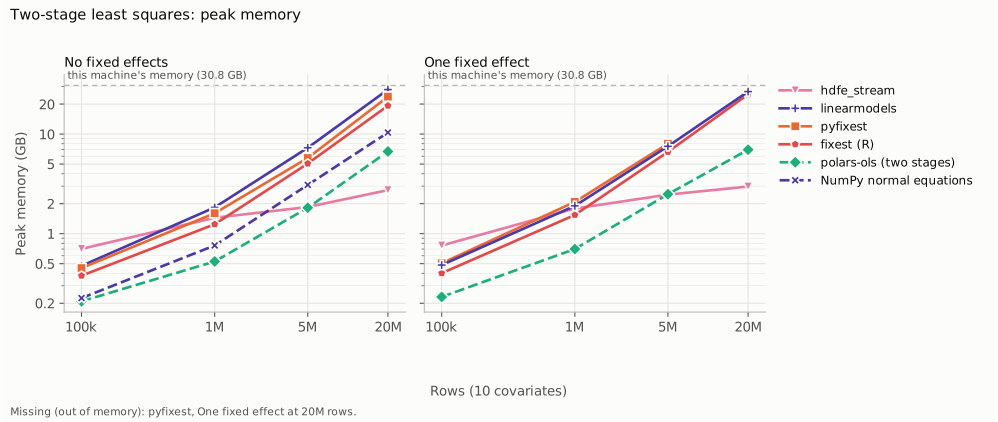
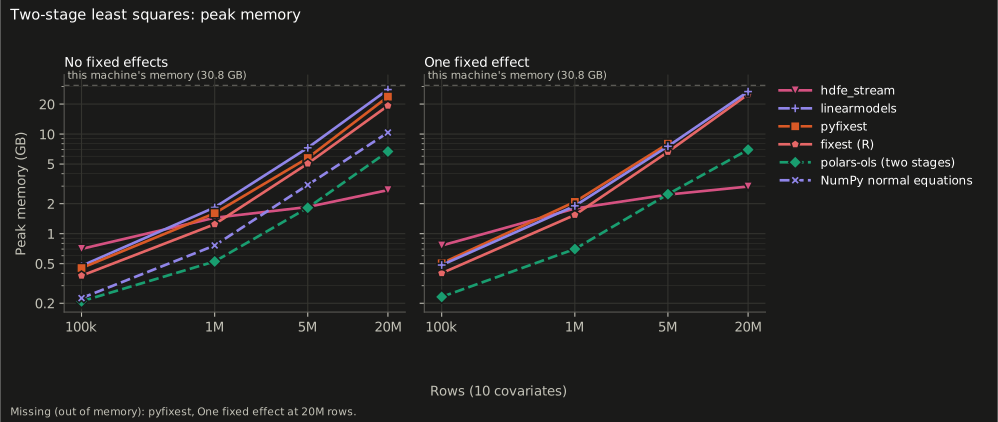
No fixed effects:
rows |
hdfe_stream |
linearmodels |
pyfixest |
fixest (R) |
polars-ols, two stages |
NumPy |
|---|---|---|---|---|---|---|
100,000 |
1.0 s, 0.7 GB |
0.70 s, 0.5 GB |
0.70 s, 0.5 GB |
0.23 s, 0.4 GB |
0.12 s, 0.2 GB |
0.03 s, 0.2 GB |
1 million |
1.7 s, 1.4 GB |
2.9 s, 1.8 GB |
1.3 s, 1.6 GB |
1.0 s, 1.2 GB |
0.69 s, 0.5 GB |
0.19 s, 0.8 GB |
5 million |
3.5 s, 1.9 GB |
13.4 s, 7.3 GB |
3.9 s, 5.8 GB |
3.2 s, 5.1 GB |
4.3 s, 1.8 GB |
0.82 s, 3.1 GB |
20 million |
10.5 s, 2.7 GB |
56.3 s, 28.0 GB |
14.7 s, 23.7 GB |
11.6 s, 19.3 GB |
17.5 s, 6.7 GB |
3.2 s, 10.4 GB |
One fixed effect:
rows |
hdfe_stream |
pyfixest |
fixest (R) |
linearmodels, demeaned first |
polars-ols, two stages |
|---|---|---|---|---|---|
100,000 |
1.1 s, 0.8 GB |
0.74 s, 0.5 GB |
0.28 s, 0.4 GB |
0.72 s, 0.5 GB |
0.13 s, 0.2 GB |
1 million |
1.9 s, 1.8 GB |
1.6 s, 2.1 GB |
1.1 s, 1.5 GB |
3.1 s, 1.9 GB |
0.71 s, 0.7 GB |
5 million |
4.6 s, 2.5 GB |
6.4 s, 8.0 GB |
3.8 s, 6.6 GB |
14.7 s, 7.5 GB |
4.2 s, 2.5 GB |
20 million |
14.0 s, 3.0 GB |
out of memory |
13.6 s, 25.1 GB |
59.5 s, 26.7 GB |
17.4 s, 7.0 GB |
Time. At 20 million rows
feols_streamtook 10.5 s without a fixed effect and 14.0 s with one. fixest took 11.6 s and 13.6 s, the hand-run two stages in polars-ols 17.5 s and 17.4 s, linearmodels 56 s and 60 s, and pyfixest 14.7 s without a fixed effect; with one it ran out of memory. At 5 million rows hdfe_stream (3.5 s) is level with fixest (3.2 s) and pyfixest (3.9 s), and almost four times as fast as linearmodels (13.4 s). With one fixed effect at 5 million rows it is 4.6 s, against 3.8 s for fixest and 6.4 s for pyfixest.Memory. 2.7 GB (3.0 GB with one fixed effect) at 20 million rows, against 6.7 to 28 GB, and 19 to 25 GB for fixest. pyfixest needed 23.7 GB without a fixed effect and was killed at this machine’s memory with one.
Logit and probit
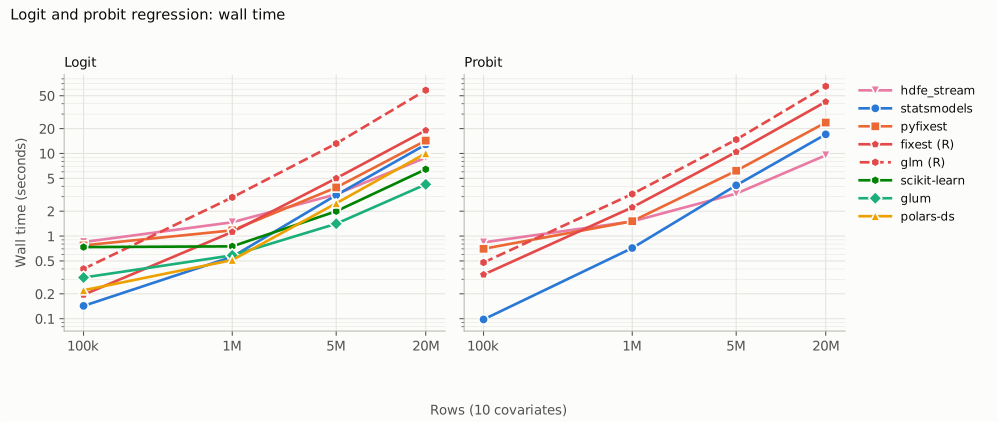
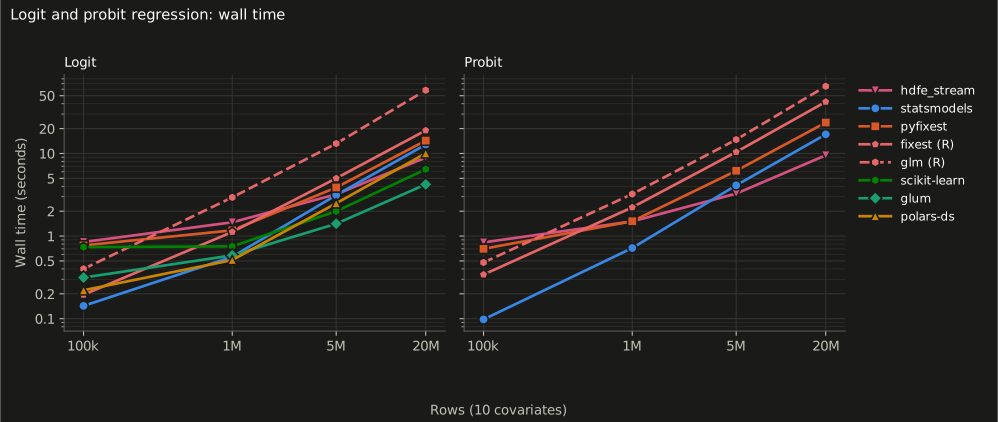
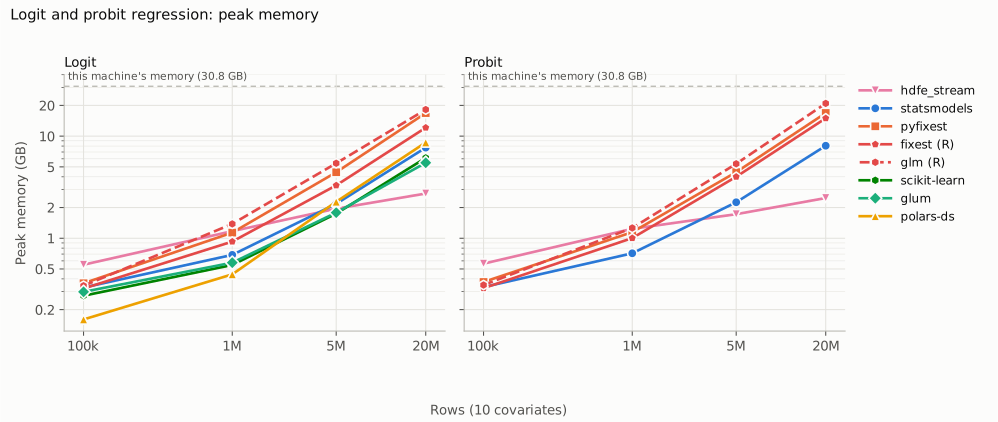
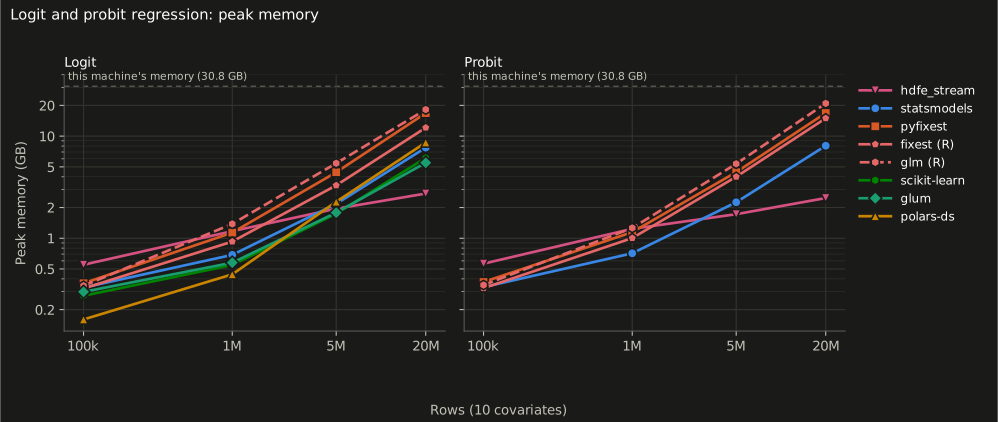
Logit, no fixed effects:
rows |
hdfe_stream |
statsmodels |
pyfixest |
fixest (R) |
glm (R) |
scikit-learn |
glum |
polars-ds |
|---|---|---|---|---|---|---|---|---|
100,000 |
0.85 s, 0.6 GB |
0.14 s, 0.3 GB |
0.77 s, 0.4 GB |
0.20 s, 0.3 GB |
0.40 s, 0.3 GB |
0.74 s, 0.3 GB |
0.32 s, 0.3 GB |
0.22 s, 0.2 GB |
1 million |
1.5 s, 1.2 GB |
0.56 s, 0.7 GB |
1.2 s, 1.1 GB |
1.1 s, 0.9 GB |
2.9 s, 1.4 GB |
0.75 s, 0.5 GB |
0.58 s, 0.6 GB |
0.51 s, 0.4 GB |
5 million |
3.2 s, 1.9 GB |
3.1 s, 2.2 GB |
3.9 s, 4.4 GB |
5.0 s, 3.3 GB |
13.2 s, 5.4 GB |
2.0 s, 1.7 GB |
1.4 s, 1.8 GB |
2.5 s, 2.3 GB |
20 million |
8.9 s, 2.7 GB |
12.8 s, 7.7 GB |
14.3 s, 16.8 GB |
19.0 s, 12.1 GB |
58.2 s, 18.2 GB |
6.4 s, 6.1 GB |
4.2 s, 5.5 GB |
10.0 s, 8.7 GB |
Probit:
rows |
hdfe_stream |
statsmodels |
pyfixest |
fixest (R) |
glm (R) |
|---|---|---|---|---|---|
100,000 |
0.84 s, 0.6 GB |
0.10 s, 0.3 GB |
0.70 s, 0.4 GB |
0.34 s, 0.3 GB |
0.48 s, 0.3 GB |
1 million |
1.5 s, 1.2 GB |
0.72 s, 0.7 GB |
1.5 s, 1.1 GB |
2.2 s, 1.0 GB |
3.2 s, 1.3 GB |
5 million |
3.3 s, 1.7 GB |
4.1 s, 2.3 GB |
6.2 s, 4.4 GB |
10.4 s, 4.0 GB |
14.7 s, 5.4 GB |
20 million |
9.5 s, 2.5 GB |
17.0 s, 8.1 GB |
23.7 s, 16.9 GB |
42.2 s, 15.0 GB |
65.0 s, 20.9 GB |
Time. At 20 million rows
feglm_streamtook 8.9 s for logit and 9.5 s for probit. Among libraries that give standard errors, that is faster than statsmodels (12.8 s, 17.0 s), pyfixest (14.3 s, 23.7 s), fixest (19.0 s, 42.2 s) and R’sglm(58 s, 65 s). The coefficients-only fits are faster for logit: glum 4.2 s and scikit-learn 6.4 s; polars-ds (10.0 s) is not. At 1 to 5 million rows statsmodels and those fits are faster than hdfe_stream (glum 1.4 s and statsmodels 3.1 s, against 3.2 s, at 5 million).Memory. 2.7 GB at 20 million rows (2.5 GB for probit), against 5.5 to 20.9 GB.
What to take from this
On data that fits in memory, hdfe_stream is a competitive general-purpose regression engine, not the fastest one. Libraries that do less work or fit only one model are faster below about 5 million rows; at 20 million, fixest is about 1.9 times faster at OLS and glum about 2.1 times faster at logit. The package’s case is that, from a few million rows, it is within a small factor of most of them and ahead of some, while using a fraction of their memory, with one interface for OLS, WLS, 2SLS and binary GLMs, standard errors that include clustering, and formulas, and that its time and memory grow slowly enough to keep going where the in-memory libraries stop.